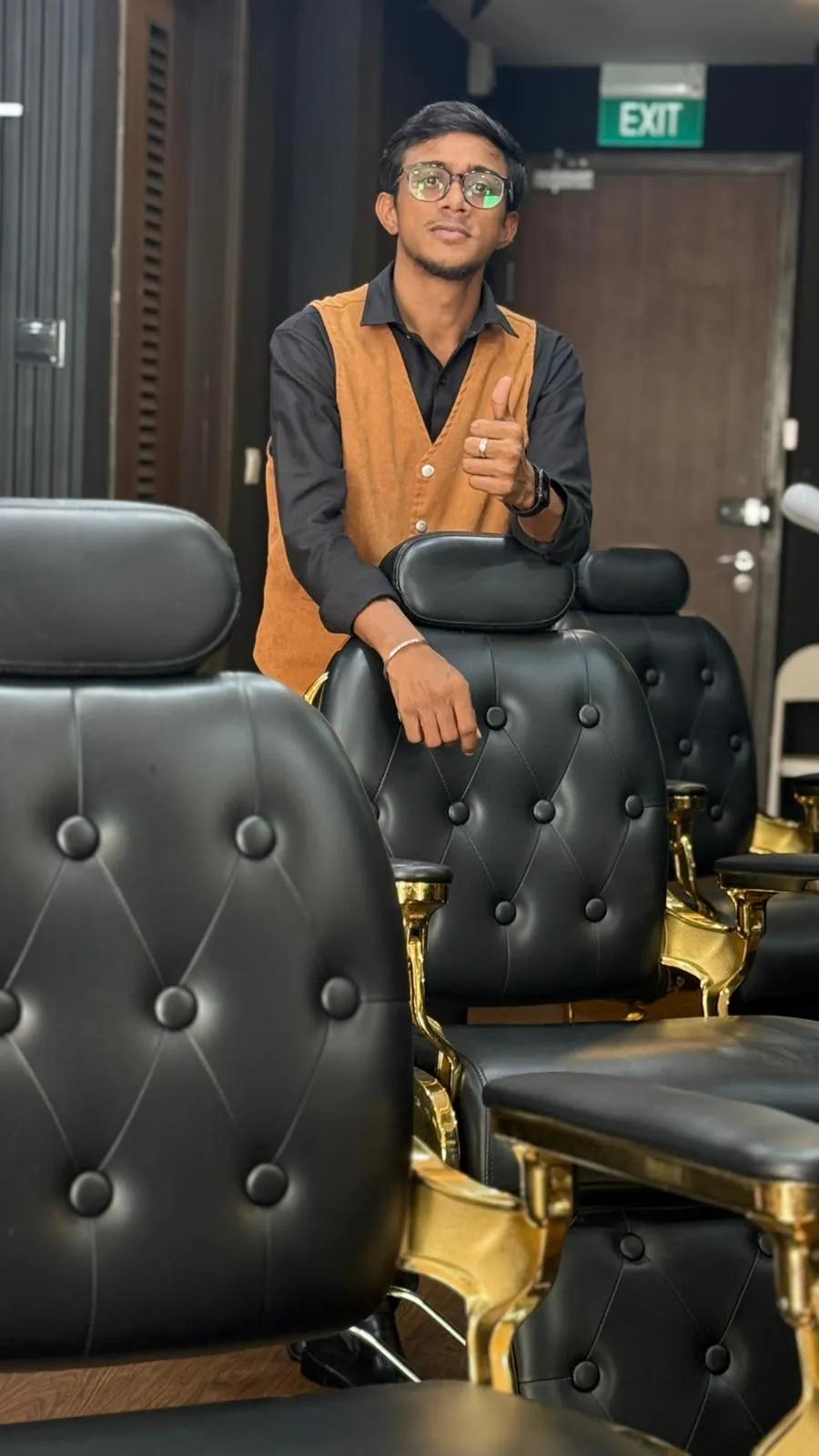

Indian men in Singapore have some of the most versatile beard-growing potential of any demographic in the city. The hair tends to grow dense, the follicle angles favour strong jawline coverage, and with the right shaping, even a two-week growth can look intentional. The problem is that most generic beard advice ignores the specific texture, growth patterns, and humidity conditions that actually matter here.
This guide covers the beard styles that work best for Indian men in Singapore in 2026: which cuts suit which face shapes, how Singapore's climate affects your grooming routine, and what a professional beard sculpt actually involves versus what you can manage at home.

Why Indian Beard Texture Needs a Different Approach
Most beard styling content is written for European or East Asian hair. Indian beard hair is typically coarser, grows at more varied angles across the face, and has a higher tendency toward patchiness in specific zones, particularly the upper cheek line and the area below the corners of the mouth.
The honest answer is that these characteristics are not problems. They are working conditions. A skilled barber shapes around them rather than fighting them.
There is also a climate reality. Singapore sits near the equator, and average humidity runs above 80 percent for most of the year. That matters for beard maintenance because sweat and humidity cause beard hair to expand and lose shape faster. Styles that rely on heavy product hold for their definition, like an aggressively styled handlebar or a waxed ducktail, will not last a full day on Orchard Road in July. Low-maintenance shapes that rely on clean lines rather than product hold are almost always the better choice here.
A well-executed beard sculpt at Platinum Cutz takes these factors into account before a single line is drawn.
The 7 Best Beard Styles for Indian Men in Singapore
1. The Short Boxed Beard
This is the most consistently flattering style across Indian face shapes, and it is underused. The boxed beard maintains a flat, horizontal bottom line across the jawline, usually kept between 5mm and 10mm in length, with the cheek line either natural or lightly defined.
It works because it does not fight sparse patches; it incorporates them into a uniform short length. It also requires almost no product. A light beard balm in the morning is enough in Singapore's climate.
Best for: Oval, round, and diamond face shapes. Also excellent for men with inconsistent growth density.
Maintenance: Every three to four weeks for a professional line-up. Daily brushing at home.
2. The Corporate Beard (Medium Length, Defined Lines)
Sometimes called the business beard in trade settings. This sits between 10mm and 20mm in total length, with sharply defined cheek lines, a clean upper neckline, and a squared or slightly rounded bottom edge.
In my chair, I see this style requested most often by Indian professionals working in the CBD, particularly around Tanjong Pagar and Raffles Place. The style photographs well, reads as polished in an office setting, and is structured enough that it still looks intentional on a Friday evening at a bar in Club Street.
The key technical detail most barbers skip: the neckline should follow the natural jaw angle rather than being placed arbitrarily. A neckline cut too high thins the face; too low and it looks unshaved rather than styled.
Best for: Oblong and square face shapes. Works well with a mid-fade or low taper haircut.
Maintenance: Professional sculpt every two to three weeks. Trim at home with a guard between appointments.

3. The Stubble Fade (Designer Stubble with Gradual Length Transition)
This is the most technically demanding style on this list and the one where DIY results most consistently disappoint. The stubble fade gradually increases in density and length from the upper cheek down toward the jaw and chin, mimicking the gradient logic of a skin fade haircut.
For Indian men with strong cheekbone coverage but patchier upper cheeks, this style is genuinely useful because it concentrates visible density where growth is strongest. The transition hides the sparse zone by design.
Done properly with clippers at decreasing guard settings and refined with a straight razor at the edges, it looks clean at a distance and deliberate up close. Book a beard sculpt with our barbers if this is the look you are after; the gradient requires precision that a home trimmer cannot replicate cleanly.
Best for: Men with uneven growth patterns. Particularly effective on oval and heart-shaped faces.
Maintenance: Every two weeks minimum. The fade loses its definition quickly.
4. The Full Beard, Shaped
A full beard on an Indian man in Singapore often gets written off as "too much" for the climate. That is wrong. What causes discomfort in humidity is not length; it is unmanaged bulk. A full beard that is thinned internally, lined properly, and trimmed to a uniform shape sits comfortably even in August heat.
The specific consideration for Indian beard texture: the hair often grows outward more than downward, which adds width rather than length. Internal thinning with scissors, not clippers, is the correct technique here. It reduces bulk without shortening the visible shape.
The Sikh community in Singapore has maintained a cultural and aesthetic tradition around full beards for generations. The grooming standards in that tradition, particularly around combing, oiling with light oils like almond or argan, and maintaining clean lines, are genuinely worth adopting regardless of your background.
Best for: Square and oblong faces. Adds definition to round faces when kept longer at the chin.
Maintenance: Monthly professional sculpt for lines. Weekly at-home oiling and brushing.
5. The Goatee with Clean Shave
A classic for a reason. The goatee concentrates growth around the mouth and chin and suits Indian men whose strongest growth zones are exactly those areas. Paired with a fully clean-shaved face, it creates strong visual contrast that makes the chin appear more defined.
The honest opinion: the goatee only works when the lines are precise. A blurry cheek-to-stubble transition without a clean shave looks unfinished. A goatee with a sharp edge and fully shaved cheeks looks intentional and modern.
Best for: Round and square face shapes. Less effective on oblong faces, where it extends vertical length unnecessarily.
Maintenance: Every 10 to 14 days for a professional clean shave and line definition.
6. The Anchor Beard
Less common, but one of the more striking options for Indian men with strong jaw structure. The anchor combines a pointed chin beard with a thin strip along the jawline and a disconnected moustache. It requires clean shaving across most of the face, so growth evenness matters less than with full or box beards.
This style suits men who want something with visual personality without committing to full beard length.
Best for: Diamond and heart-shaped faces. Strong jaws in particular.
Maintenance: High. Every two weeks minimum for clean shave and reshaping.
7. The Van Dyke
A fuller evolution of the anchor. The Van Dyke separates the moustache and chin beard with clean-shaved cheeks, but both elements are fuller than in the anchor style. The moustache is often styled with a slight curl at the ends.
In Singapore's humidity, the moustache curl requires a light beard wax, not a heavy wax. Apply a rice-grain amount to dry hair after the morning commute, not before stepping outside.
Best for: Oval and heart-shaped faces. A confident choice for men who attend formal or creative industry events.
Maintenance: Every two to three weeks professionally. Daily product discipline at home.
