Indian Barber in Singapore: Why Multilingual Grooming Matters More Than You Think (2026)
Finding an Indian barber in Singapore who genuinely understands multilingual grooming is easier said than done. You can walk into any busy barbershop along Serangoon Road or Orchard, sit down, and still leave with a haircut that missed the brief enti
Finding an Indian barber in Singapore who genuinely understands multilingual grooming is easier said than done. You can walk into any busy barbershop along Serangoon Road or Orchard, sit down, and still leave with a haircut that missed the brief entirely — not because the barber lacked skill, but because the conversation never fully landed.
This article covers what multilingual grooming actually means in a Singapore context, why it matters for men with South Asian, Malay, and Chinese hair types, and how to find a barber who can work across language and culture without making you point at a photo and hope for the best.
What "Multilingual Grooming" Actually Means in Singapore
The term sounds marketing-friendly, but it describes something real. Singapore's male grooming market serves clients who speak Mandarin, Tamil, Malay, Hindi, Hokkien, and English — sometimes switching between two or three in the same appointment. When a barber can communicate in Tamil or Malay, a client who struggles to describe "tapered on the sides, left heavier on top" in English no longer has to compromise.
Multilingual grooming is not just about language fluency. It also means cultural literacy: knowing that a traditional Indian client might want a clean line-up for a wedding function at Sri Veeramakaliamman Temple, or that a Malay client ahead of Hari Raya wants something that holds through long family gatherings without looking flat by afternoon.
In my chair, I see this every week: a client comes in, shows me a photo on their phone, and then the real brief comes out in the conversation after. That conversation only happens fully when the language barrier is gone.
Why Hair Type and Cultural Context Go Together
South Asian Hair: What Most Barbers Get Wrong
Thick, coarse, often high-density hair is the norm across South Indian and Sri Lankan Tamil communities in Singapore. This hair type resists blending at the fade line if the barber rushes the guard transitions. A common mistake is jumping from a 0.5 to a 2 without a blending guard in between, leaving a visible step that reads as a hard line instead of a taper.
The honest answer is that many general barbershops in Singapore are set up for the more common Chinese or Eurasian hair texture, and their barbers default to techniques that work for finer, lower-density hair. That is not a criticism. It is just the reality of volume-driven shops where the clientele skews one way.
For thick South Asian hair specifically:
Scissor-over-comb technique at the occipital bone produces cleaner results than clipper-only blending
Detailing cream or light clay finishes tend to hold better than water-based pomades, especially in Singapore's humidity (water-based products reactivate through sweat, which is less than ideal when you are commuting from Jurong East in July)
Line-up definition matters more at the temples for many Indian clients, where a sharp edge frames the face more effectively than a faded hairline
Malay Hair Textures: Natural Body That Needs Direction
Malay hair often carries natural wave and body, which is an asset when worked with correctly. The challenge is distribution: product applied too heavily at the roots kills the movement that gives the style its shape. A barber who understands this will work the product through from mid-shaft and finish with a light touch at the scalp.
Chinese and Eurasian Hair: Where Singapore's Market is Already Well-Served
Straight, fine-to-medium density hair dominates the Chinese Singaporean demographic, and most barbershops in the city-state are well calibrated for it. Techniques like the disconnected undercut, textured fringe, and classic taper work without much adaptation. This is the hair type that most local barbershop training defaults to.
The Barbershop Scene in Singapore: Where Indian and Multilingual Barbers Work
Precision cuts from $28Scissor sculpts and textured crops. 3 studios.· All studios open till midnight
Singapore's barbershop landscape is strong, but not every shop covers multilingual service or South Asian hair expertise. Here is an honest look at the current scene.
Truefitt and Hill (Wheelock Place, Orchard)
One of Singapore's most established grooming institutions, Truefitt and Hill brings British barbering tradition to a local market. Their barbers are trained to a high technical standard, and the experience is polished. Pricing sits at the premium end, with haircuts starting from SGD 60 and above. The shop suits clients who want a quiet, formal environment and are comfortable communicating in English. Multilingual service in Tamil or Malay is not a documented feature.
Sultans of Shave (Multiple Outlets)
Sultans of Shave has built a loyal following across their outlets in Bugis and elsewhere. They handle a diverse clientele and are known for clean fades and solid shave experiences. Prices are mid-range, typically SGD 35 to 55 for a full service. They appeal strongly to younger working professionals looking for a reliable cut without a long wait. Multilingual capability varies by barber at each outlet.
Blind Barber (Tanjong Pagar)
Blind Barber leans into the lifestyle barbershop concept, with strong social media presence and a younger, style-conscious crowd. Their cutting is trend-led, which works well for clients who want current looks. Situated near Tanjong Pagar MRT (EW Line), it is convenient for CBD workers. Pricing is in the SGD 40 to 65 range. Cultural grooming nuance for South Asian clients is not a specific focus.
The Panic Room (Telok Ayer)
The Panic Room is known for its relaxed atmosphere and attention to detail, with barbers who take their time on blending and finishing. Located near Telok Ayer MRT (DT Line), it draws a mixed crowd from the CBD. Expect SGD 40 to 60 for most services. English is the primary service language.
Platinum Cutz: Where Multilingual Grooming Is a Daily Reality
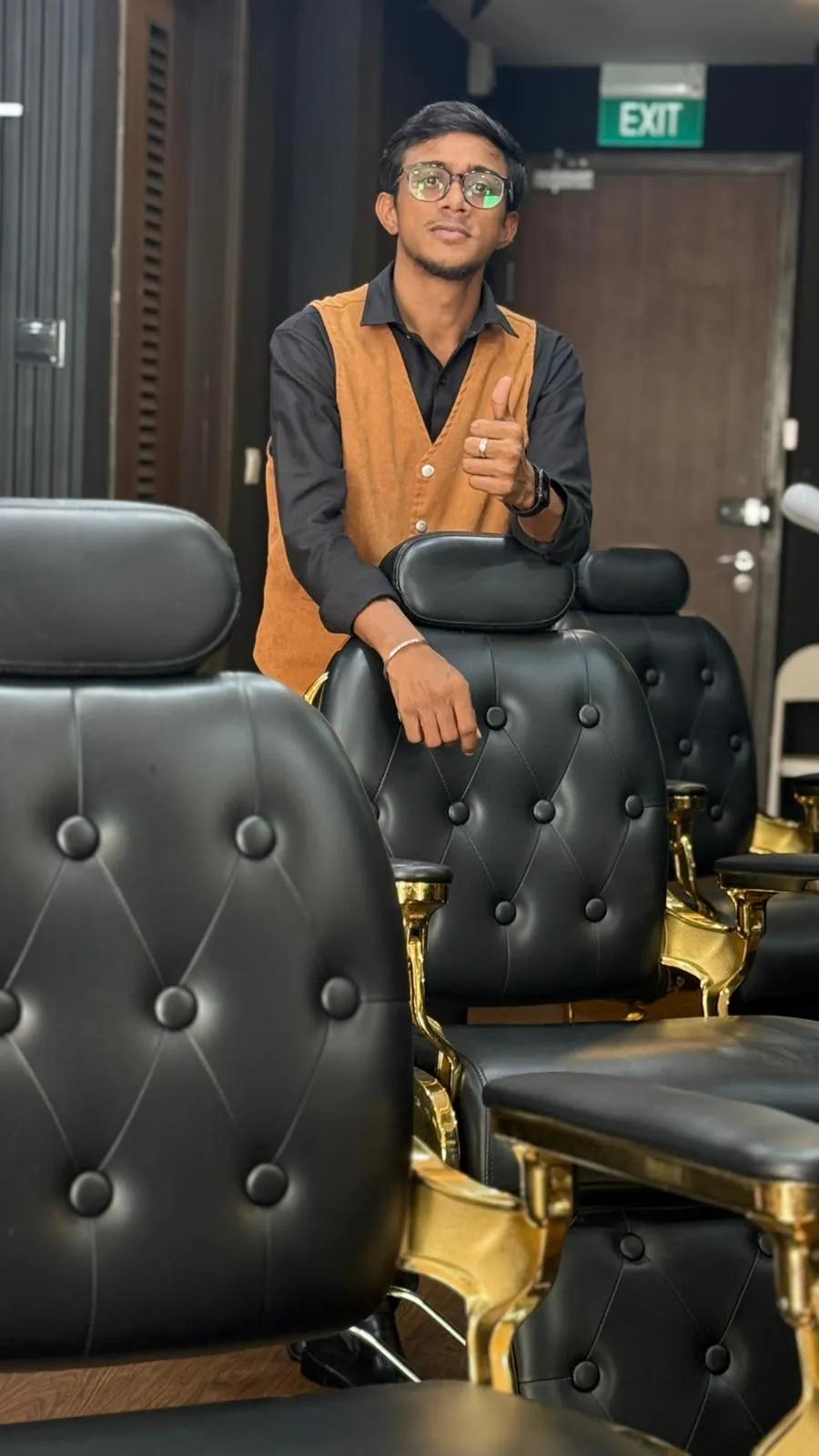
Platinum Cutz is where multilingual grooming is not a selling point — it is just how the shop operates. Ugan, based at Platinum Cutz Singapore, brings Tamil and English fluency to appointments, meaning Tamil-speaking clients from Little India, Serangoon, and Geylang can communicate the full brief without switching to approximations in English.
Haircuts at Platinum Cutz start from SGD 28, with full grooming packages available. Platinum Cutz holds a 4.9-star Google rating, and the shop's clientele reflects the actual demographic diversity of Singapore rather than a single dominant community. See the full services menu and gallery of past work before booking.
The Little India and Serangoon Corridor: Where Indian Barbers Are Concentrated
The stretch from Farrer Park MRT (NE Line) to Little India MRT (NE/DT Lines) along Serangoon Road is where traditional Indian barbering has operated in Singapore for decades. You will find small shopfront barbers offering cuts from SGD 8 to 15, most using traditional straight-razor techniques for hairline definition that modern clipper-only shops do not replicate. The trade-off is that many of these shops are walk-in only, with waits that can stretch past an hour on weekends, and the range of modern styles is limited.
For South Asian clients who want both Tamil-language service and contemporary men's hairstyles (skin fades, textured crops, modern tapers), the Little India shopfront barbers are often not the answer. They serve a specific need well, but they are not set up for the blended fade work that dominates current men's grooming trends.
Multilingual Barbershops Beyond the Indian Community
Singapore's grooming diversity runs in multiple directions. Here is what multilingual service looks like across different communities.
Mandarin-speaking clients are well served across the city, with most barbershops in heartland areas like Bedok Interchange, Tampines Hub, and Jurong Point operating naturally in Mandarin alongside English.
Malay-speaking clients find service in Malay across Geylang, Tampines, and areas around Woodlands and Yishun where Malay-speaking barbers are embedded in the local barbershop landscape.
Tamil-speaking clients have fewer options if they want Tamil fluency combined with current men's hairstyle capability. The traditional Little India barbers offer the language. Modern lifestyle barbershops typically do not. Platinum Cutz sits in the gap between both.
Explore the Platinum Cutz barber team to find a barber whose language and style speciality matches yours.
How to Find the Right Indian Barber in Singapore: A Practical Guide
Most men approach this wrong. They search "Indian barber near me" and sort by proximity. Proximity is the last thing to optimise for.
The sequence that actually works:
Identify your hair type and the style you want. If you have thick South Asian hair and want a skin fade into a textured top, filter for barbers with documented fade work on similar hair types. Instagram and the Platinum Cutz gallery are more useful here than Google Maps.
Confirm language capability before you book. Do not assume. A Tamil or Hindi name on the booking profile does not guarantee the barber actively serves clients in that language. Platinum Cutz makes this information available through the barber profile page.
Check the haircut pricing against what is included. Some shops charge separately for wash, styling, and line-up. A SGD 28 cut that includes all three is better value than a SGD 35 cut that itemises each step.
Read reviews from clients with your hair type. A 4.9-star rating is meaningful. A 4.9-star rating with reviews that mention thick or South Asian hair specifically is what you are looking for.
FAQ: Indian Barber in Singapore and Multilingual Grooming
What is an Indian barber in Singapore?
An Indian barber in Singapore typically refers to a barber of South Asian descent who may offer service in Tamil, Hindi, or Malayalam, and who has experience working with South Asian hair textures. In Singapore, Indian barbers are concentrated around Little India and Serangoon Road, though barbers like Ugan at Platinum Cutz operate across wider areas of the city.
How much does an Indian barber charge for a haircut in Singapore?
Traditional shopfront Indian barbers in Little India charge SGD 8 to 15 for a standard cut. Modern barbershops with Indian barbers offering multilingual service and contemporary styles, like Platinum Cutz, start from SGD 28 for a haircut. Pricing varies depending on technique complexity and whether styling is included.
Can I get a Tamil-language haircut appointment in Singapore?
Yes. Ugan at Platinum Cutz Singapore offers appointments where Tamil is the primary service language. You can book directly and specify your preference. This is uncommon at mainstream barbershops in Singapore outside of the Little India corridor.
Which Singapore barbershops are best for thick South Asian hair?
Barbershops with documented fade and texture work on South Asian hair are the best fit. Platinum Cutz has a 4.9-star Google rating and specific experience with high-density Indian hair. If you are looking at other options, check Instagram portfolios for fade work on coarse hair before booking.
Is multilingual grooming only relevant for Indian clients?
No. Multilingual grooming is relevant across Singapore's Chinese, Malay, and South Asian communities. Mandarin service is widely available in heartland shops. Tamil service at a modern barbershop level is rarer. Malay service is available in areas like Tampines and Woodlands. The benefit is the same across languages: a clearer brief produces a better haircut.
What hairstyles work best for South Asian men in Singapore's climate?
Textured crops, tapered sides with a longer top, and high fades work well because they reduce the bulk that makes thick hair feel heavy in humidity. Styles that require daily product commitment are harder to maintain when humidity causes products to break down quickly. A barber who understands both hair type and Singapore's climate will factor this into the recommendation.
Where are Indian barbers located in Singapore outside of Little India?
Beyond the Serangoon Road corridor, Indian barbers with modern grooming skills operate across Tanjong Pagar, Jurong, and the CBD area. Platinum Cutz locations cover multiple areas of Singapore. Check the barber team page to find the right fit by area and language.
How often should South Asian men in Singapore get a haircut?
For maintained fades and tapered styles, every 3 to 4 weeks is standard. South Asian hair grows at roughly the same rate as other hair types, but high-density hair makes growth more visible at the fade line. If you are maintaining a sharp line-up, 2 to 3 weeks is a more realistic interval.
About Ugan
Ugan is a barber at Platinum Cutz Singapore who specialises in skin fade blending on high-density South Asian hair and offers full Tamil-language appointments for clients who prefer to brief in their first language. Book an appointment and see the work in person.
The Right Barber Is a Communication Problem as Much as a Skill Problem
The best haircut you have ever had probably came from an appointment where you said exactly what you wanted and the barber understood it completely. That is not luck. That is what happens when language, cultural context, and technical skill line up in the same chair.
Singapore has talented barbers across every community. The gap is not in cutting ability. It is in the combination of modern fade technique, South Asian hair knowledge, and Tamil or Malay language service sitting together in one appointment. That combination is what multilingual grooming actually means, and it is what makes the difference between pointing at a photo and hoping, versus walking out exactly as planned.
Uganthiran — known as Ugan — brings 8 years of professional barbering experience to Platinum Cutz Clarke Quay, backed by formal certification from Mathy Hair Studio & Academy. His work is defined by clean precision: structured skin fades and taper fades, textured crops, and beard sculpting tailored to each client's face shape and lifestyle. Ugan runs a thorough consultation before every session, believing the best cuts come from understanding the client — not just the hair.